We are happy to share some of our ideas behind Crossing Grieg - Opus 72 reimagined - an album by Håkon and Nils Henrik Asheim. The present article is a companion to the album, following it from start to end.
Use this article the way you need it - zapping your own shortcuts through the 50+ sound snippets, feeding your curiosity on artistic processes, seeking answers to specific musico-historical questions, hoping to grasp the mysterious codes of Norwegian fiddle tradition, looking for musical structures through the visualization of score excerpts, while getting on the inside of our main research question, maybe to start forming your own answers?
Each of the 17 tracks presents its own solution to this basic challenge: How can the original Hardanger fiddle slåtter be merged with Edvard Grieg's piano adaptions, keeping key characteristics from both while creating a new, combined musical flow? And there is no definitive answer - choices have to be made, again and again.
We will be referring a lot to Knut Dahle, Edvard Grieg's source, the man who played the slåtter (fiddle dances) for Johan Halvorsen who wrote them down. More info on this can be found in the album booklet and in the reference list at the bottom of this article. All sound examples are from the Crossing Grieg album, which you maybe already purchased?
Welcome inside.
1. WEDDING MARCH AFTER MYLLARGUTEN
Myllarguten (Torgeir Augundson, 1801– 1872) was the most famous Hardanger fiddle player of the 19th century. He rose to fame after Ole Bull had him perform during a concert in Kristiania in 1849. This slått has never been used as a regular wedding march, as it was composed when his girlfriend betrayed him and married another man.
---
This track is the perfect soft introduction to the whole context. First, you can hear the entire slått in its original form. Next, you are presented with a mostly unchanged Grieg version of exactly the same music. This is the frame, the scope we are working within.
At the end of the fiddle version, the piano joins gradually, adapting to the fiddle rhythm, surfing on this wave in order to carry Grieg's version forward. The small echoes added by the fiddle during the piano's solo parts are thought of as a reminder of its presence in the room. Listen to the transition between fiddle and piano:
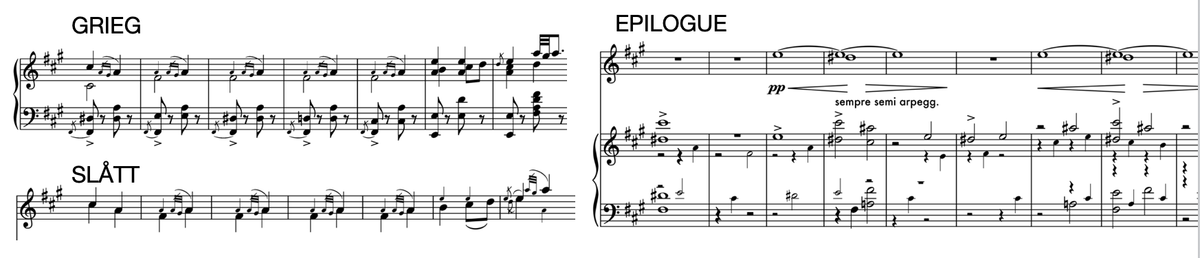
The fiddle is tuned AEAE, as the piece runs in A major. In the middle part it is Grieg's turn to present the melody. Inspired by the fiddle's F# bottom note, he turns it temporarily to f# minor with a chromatic middle voice. A treat of his romantic style, somehow alien to folk music, but happens to work very well when the fiddle joins. Ex.1.
Apart from serving as accompaniment, these bell-like chords are beautiful on their own. So we use them to build a sketch-like epilogue where the sense of time is stretched and dissolved. The D# from Grieg also inspires an A#, projecting the dissonance to the next level. Ex.2.
Wedding March after Myllarguten on youtube
2. JON VESTAFE'S SPRINGAR
In Tinn, where Knut Dahle lived, the fiddler Jon Kjos (1754–1826) was referred to as Jon Vestafe (‘from the west’). He was one of Myllarguten's playing teachers.
---
From here, the fiddle is tuned ADAE and will stay this way through track 13 of the album. Tuning is partly the reason for the order of tracks on the album, the same order we use for live concerts, keeping re-tuning time to a minimum.
Welcome to the asymmetrical rhythm! Asymmetry (varying the length of the beats) is common in many Norwegian and Swedish folk dances in triple metre. In the Telemark springar, the pattern is ‘long–medium–short’. The piano aims to follow the fiddle's lead in this pattern:
Towards the end of this example you might have heard an extra beat inserted, compared to Grieg's original, if you are familiar with that one. This because we rectified the inverted rhythm that Grieg applies in some sections. This meaning that we have moved Grieg's bar line one beat to the right, corresponding to the generally accepted understanding of rhythm in the Springar tunes in the folk music tradition (This, along with similar adjustments in the other slåtter, was also implemented in the 2001 Grieg edition by Geir Henning Braaten and Sven Nyhus). Ex.1.
Now to the piano introduction and how we love to take some of Grieg's new creations one step (or two) further. In his opening bass figure, Grieg creates a jumping rhythmic counterpoint, with bold intervals of fourths and fifths. In our version, the piano builds up to this figure over time - starting from an exploded state, as if collecting bits and pieces trying to fit them together. Ex.2.
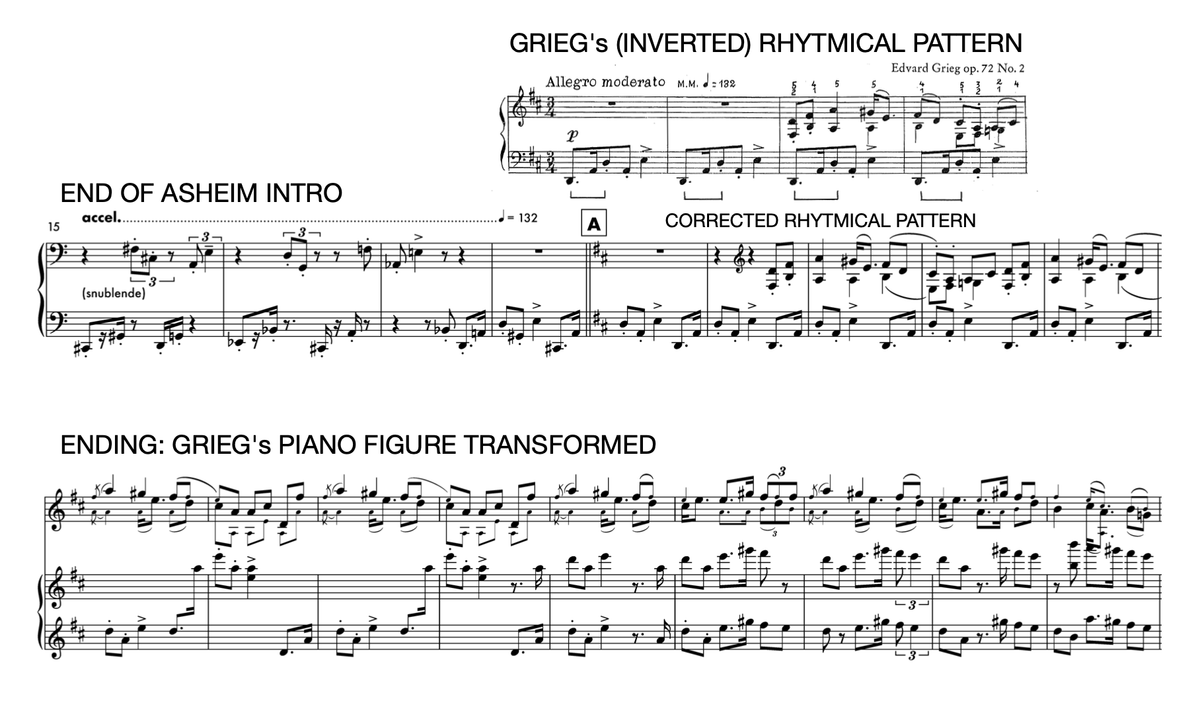
After the intro, the piano follows Grieg's original, first as solo and then with fiddle, just omitting a few Grieg notes here and there in order to not cover the fiddle sound. But when Grieg arrives at his most piano-hammering culmination (the return of the start of the slått theme), we had to make a choice. We kept the fortissimo-Grieg, and gave the fiddle only some single bow strokes that could carry through the piano sound. In return, the fiddle takes the lead again thereafter, with the piano playing light figures derived from Grieg's bass. The placement in the treble will make it possible to hear more of the fiddle's whole resonance. Ex.3
Jon Vestafe's Springar on youtube
3. KNUT LURÅSEN'S HALLING II
Knut Lurås (1782–1843) was one of the most renowned Hardanger fiddle players of his generation. He was also from Tinn and the source of much of Knut Dahle’s repertoire.
This fiddle tune (as well as the other one named after Knut Lurås) is usually considered a gangar, not a halling. Though Knut Dahle called it a halling, the tempo noted by Halvorsen and retained by Grieg (MM 76) suggests that he played it more like a gangar – the halling dance requires a faster tempo.
---
A twin form! Since the phrases of the slått are played twice, we take the opportunity to present fiddle and piano in alternation. Grieg's writing here is so inspired - let's give him the first round (still, trying to play the piano in a "fiddle" way - leaning forward and not being too lyrical/romantic).
Then, for the second round add the fiddle, damping the treble of the piano and some of the G/G# notes but keeping the rest of Grieg. Such a thing can work or not work - we tried it, and found that it matched!
Just a little interesting difference can be heard in the 3 first notes of the melody. Played by the piano, the upper voice (Open A string) dominates, but the fiddle makes the actual melody clear: F#-E-D.
Next example is where the fiddle and our friend Grieg part ways. Grieg's bar 32 marks the pianissimo start of a monumental escalation, dynamically and harmonically. So we let the fiddle do it the proper way first, with the piano just gently supporting. The left hand maybe pointing towards Grieg in its alternating fundamental notes, but still keeping within the space of the fiddle harmony. Ex.1a. Then, let Grieg be Grieg. Ex.1b.
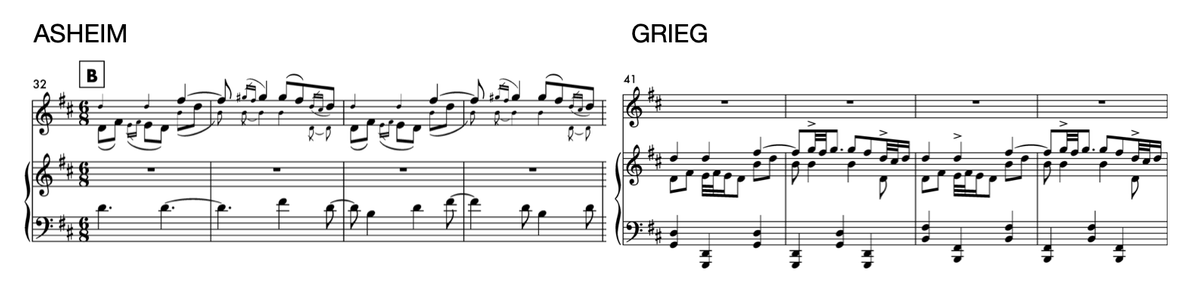
At the end of the example, you just heard Grieg's bar 41-53 with a little rhythmic difference from the fiddle (the Johannes Dahle version). Dotted notes are replaced by even eight notes. The very nice thing Grieg does here is to introduce offbeat notes for intensification. That matches very well the style of the fiddle phrasing, so the two live well side by side here, enhancing eachother.
Finally: Grieg from bar 64 does a modulation not at all compatible with the fiddle, but so beautiful we couldn't live without. Result: piano solo.
Knut Luråsens Halling II on youtube
4. HÅVARD GIBØEN'S DREAM BY THE OTERHOLT BRIDGE, springar
Håvard Gibøen (1809-73) was considered as skilled a fiddler as Myllarguten but did not have the opportunity to become known beyond his local area. Knut Dahle learnt a lot from him.
One day, when Håvard Gibøen was on his way home on foot and needed to rest, he fell asleep under a bridge. He then dreamt the tune. The fiddle combines the version notated by Halvorsen with the one recorded by Johannes Dahle.
---
Again, as in Jon Vestafe's Springar, we find asymmetrical metre in the fiddle performance. Contrary to the inverted rhythm from Halvorsen's transcription, we let the melody start on an upbeat instead of the first beat.
Actually there is not much left of Grieg in this piece. First, in the initial improvisation, the piano borrows from the slått and not from Grieg.
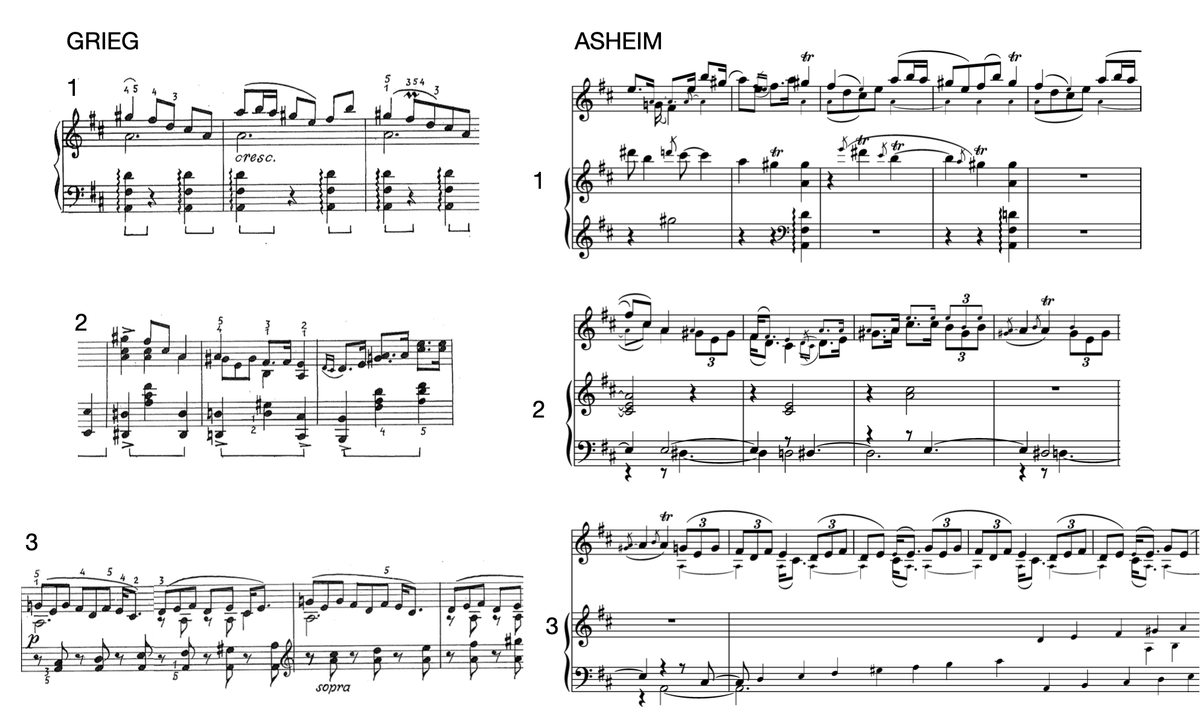
After the intro, we just picked three very characteristic, isolated elements that color the slått in a nice way: a D chord with A in the bass (Grieg bar 22, Ex.1), a minor second of D/D sharp in the bass (Grieg bar 35, Ex.2), and an ascending scale (Grieg bar 42, Ex.3.). These elements are not fitted with the tune the way Grieg do, they are more loosely mounted.
example 1
example 2
example 3
Håvard Gibøen's Dream on youtube
5. PRILLAREN FRÅ OS, springar
What is a Prillar ? Folk flutes, often referred to as ‘prillar flutes’ (made from bone, horn, or wood). They may also have been used to play this tune besides the fiddle.
---
Well this was really an exercise for the piano - how to emulate the fiddle's asymmetric playing? The problem lies in the conflict between rhythmical groove and phrase shaping. Especially at the end of each second bar, the melody comes to a conclusion which, beause of the piano harmony, becomes quite abrupt if played in the 'fiddle' rhythm (short duration for the 3rd beat). So we chose to do a tiny prolongation in these endings. At least, the asymmetric 'stumbling character' is kept.

What you hear in the piano is original Grieg, except that Grieg's bars 19–22 (repeating the preceding four bars) are omitted in order to follow the slått structure.
A little epilogue is added, as a suspension/prolongation of Grieg's final cadenza and the typical looped ending figures in the fiddle.
6. SPRINGAR AFTER MYLLARGUTEN
Again, there is asymmetrical metre in this slått, like all the other springars.
---
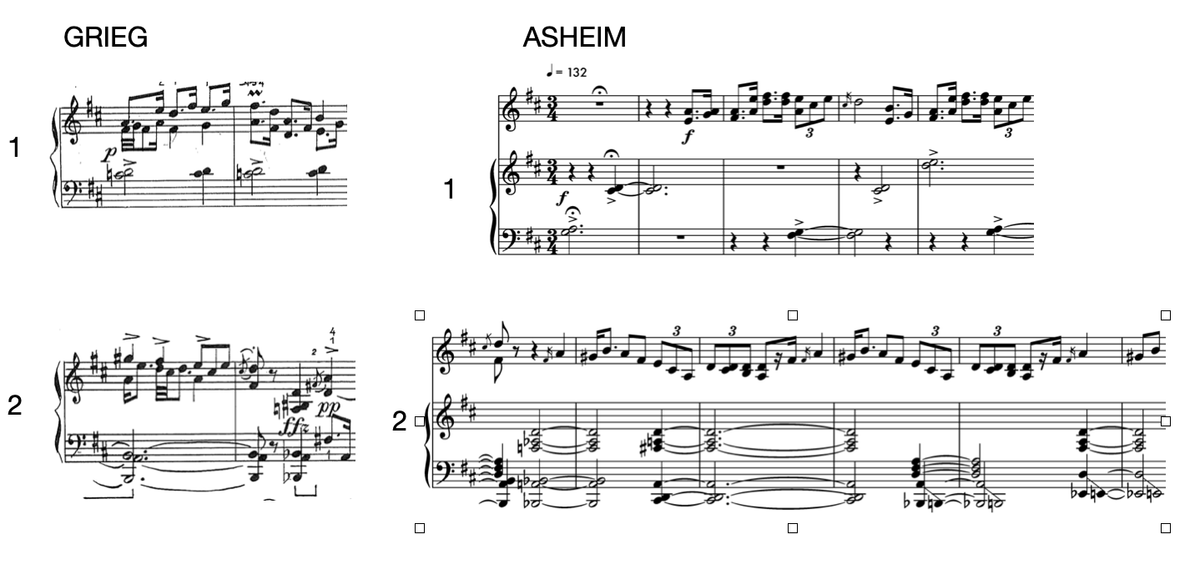
So what is the key element in Grieg's version here? We chose the accentuated interval of a second. Clearly manifested by the major second C-D in the left hand of Grieg's bar 15-20, the only bars in this piece where we play Grieg directly.
For the rest, this little cluster is lifted out of context, changed to a minor second, and used from the very beginning to build up our piano part (Ex.1).
After his bar 20, Grieg further elaborates on the dissonance, adding extra bass notes to the accentuated triads from bar 22, culminating in a fantastic cluster chord in bar 26 (Ex.2). This chord is then further developed by us: Instead of, like Grieg, calming down the music towards the end, we insist on the chord, moving it upwards in register.
Springar after Myllarguten on youtube
7. RØTNAMS KNUT, halling
The title refers to Knut Rotneim (1809–1851), a famous folk dancer from Hallingdal. This is perhaps the Hardanger fiddle folk tune with the most variants across the country. One of these was included by Grieg in his Album for Male Voices (Op. 30:12), along with the lyrics associated with the tune, which recount the dancing skills and extraordinary powers of ‘Røtnamsknut’.
---
Here we let the fiddle start the tune in all its groovy rock'n roll way, and let the piano enter by swimming in its wake. That's the way to get the right rhythmic energy from the beginning. Here from the transition to Grieg:
About the slått itself: Håkon chose a variant slightly different from Halvorsen/Grieg, one has been widely used from around 1900 onwards by fiddlers from various regions, actually more as a concert piece than for dancing. As the fiddle returns with a vengeance after some Grieg piano bashing, we can hear it with our own piano accompaniment, which we derived from Grieg's final ascending chord sequence:
What happened in end of the passage you just heard, was a gradual takeover by the piano, inspired by the Lydian tonality of the fiddle, expanded by Nils Henrik with more and more major seconds, becoming major thirds, eventually losing the sense of tonality in order to clear the table for the minor section (See example).
This middle section with its transformation of the tune into a slow melody in minor key is entirely Grieg’s invention, not part of the traditional slått. Listen to this section's middle part in F major where we include the fiddle, keeping strictly Lydian (with B naturals) like Grieg, even omitting the one occurrence of a Bb in his harmonisation at the end of the phrase.
Grieg's reprise of the main section is not included - in our concerts we prefer to go straight to the next slått, to keep the flow.
8. GANGAR AFTER MYLLARGUTEN
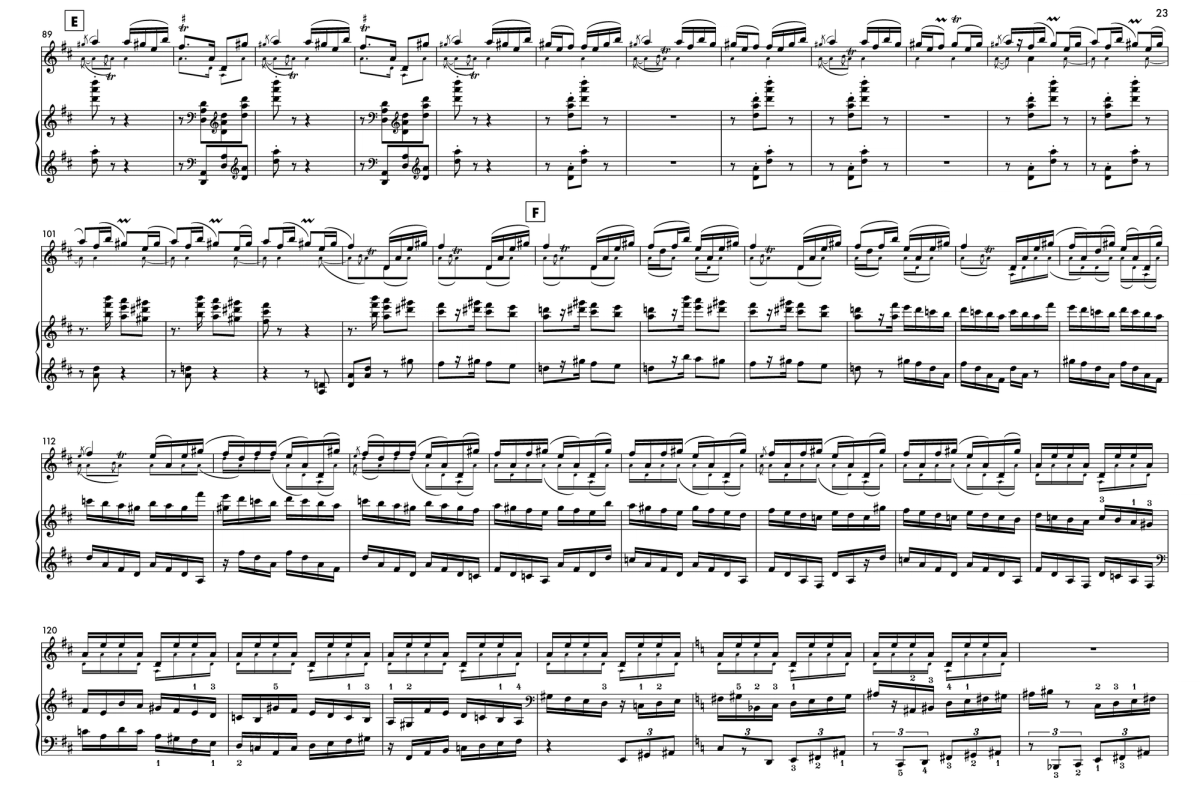
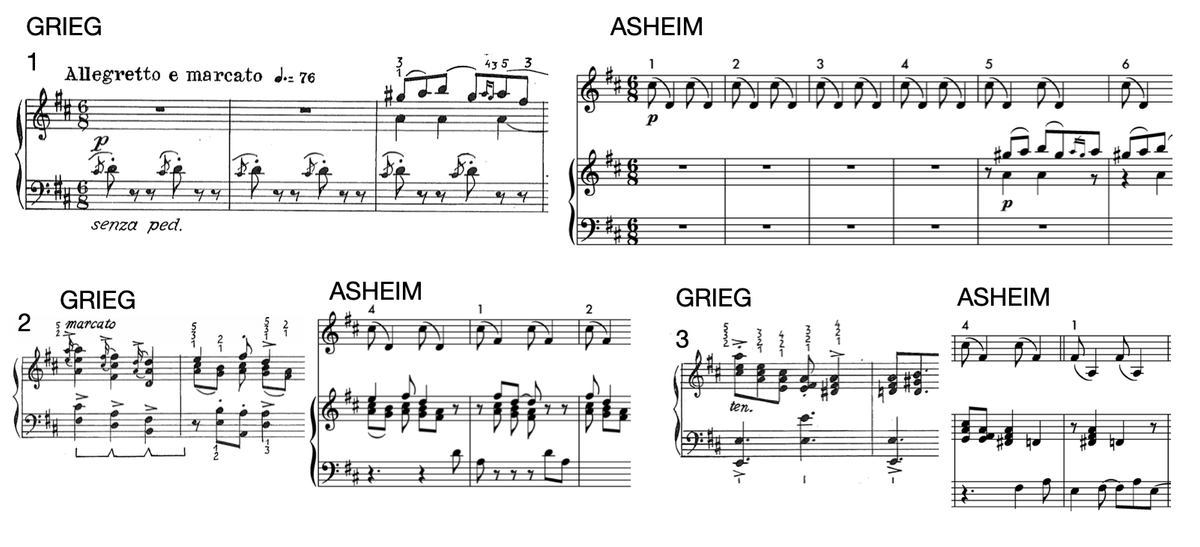
This piece is the only one with no melody in the fiddle. Not a single bit of the slått, only a looping figure alternating between two strings. Somehow it is an avatar for Grieg's left hand - the semitone interval c#-d is inverted to a major seventh. An ornament becomes something else (Ex.1).
This figure is in 6/8 meter, while the piano's structure is built of 5/8 modules. Two slightly different cogwheels in a clockwork. The piano plays the melodic role of the fiddle, by extracting modules from Grieg's right hand, looping them. It slowly advances in the melodic line by skipping one place every loop.
Sometimes it will, as in the beginning, be close to the original fiddle notes. Sometimes it will be colored by typical Grieg traits - for example expansion of the harmony to triads and chromatic inflections (Ex.2 & 3 show where the elements are borrowed, and what they become)
Ex.2
Ex.3
Gangar after Myllarguten on youtube
9. THE BRIDE FROM SKULDAL, gangar
According to his grandson Gunnar, Knut Dahle used to play some tunes while waiting for his morning coffee, most often starting with this one. That it was a favourite tune of his, is perhaps reflected in Halvorsen's comment to Grieg: "Among the gangar tunes, I think 'Skuldalsbruri' takes the first prize".
The title refers to a young girl from Skuldal who took her own life when she was forced to marry. She is said to have hummed this tune shortly before it happened.
---
Just like in track nr.6, a key element of Grieg's piano writing is taken out of its context, enlarged and developed. We are talking about the heavy left hand fifths, which we develop to more complex, towering chords. We remove their rhythm, but keep the pace of the few first root notes, in relation to the melody. From bar 4 of the melody - B minor in the bass, three bars later E7, then A (Ex.1).
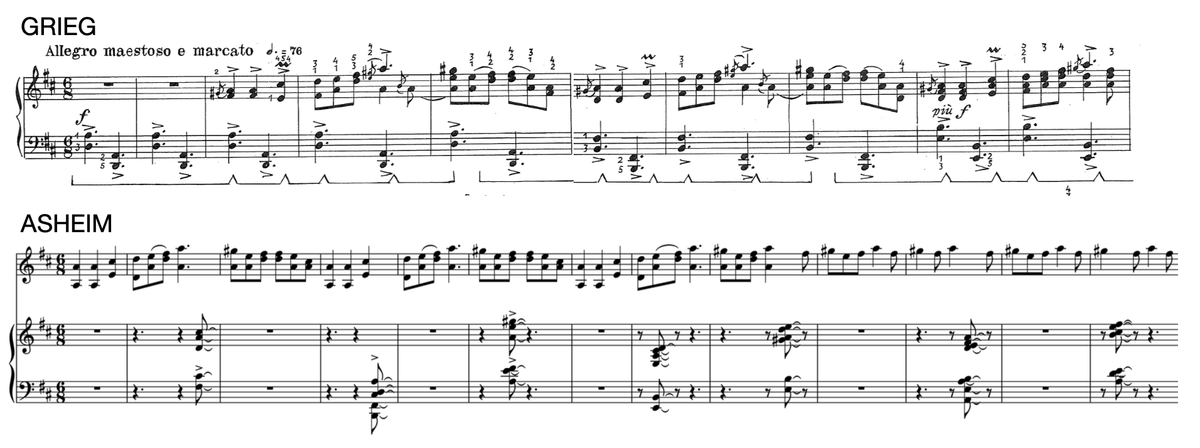
Our version also includes a longer introduction, presenting these bass chords as an independent element in their own slow time. The added sevenths and ninths (which you already saw in the example above) simply represent a stacking of the intervals which occur in Grieg's piano version when right hand lines meet left hand fifths.
But have no fear, you will hear some pure Grieg too - the whole second half of the piece follows him from note to note. First as piano solo, later with added fiddle.
10. HILL TUNE - Haugelått, halling
The slått belongs to Knut Dahle’s family tradition. His great-grandfather, the fiddler Brynjulv Olsson, had lost a bull and heard a hulder (a forest spirit) sing: ‘Play this, Brynjulf Olsson, when you return home to your wife and children – and you shall find your bull beyond the mountain top’.
---
Although Opus 72 is genuinely a Grieg composition, it is fascinating to see with which fidelity he handled the original material. We tried to play the two together, and found it very charming how the original fiddle part perfectly matches Grieg's version. No harmonic or rhytmic invention stands in the way of the folk music here. Ex.1.
Grieg's innovation is the middle part. Exactly as in nr.7, Røtnamsknut, he transforms the theme to a half-speed minor key mourning song. We took the fiddle along in Grieg's landscape. Ex.2.
Finally, the piano elaborates on the atmosphere of Grieg's slow melody by turning it to a melodic never-ending snake, with an ending that presages the start of next track. Ex.3.
11. NILS REKVE'S HALLING
Nils Rekve (1777–1846) from Voss was a renowned folk musician, and this tune may have travelled to Telemark via Knut Lurås.
---
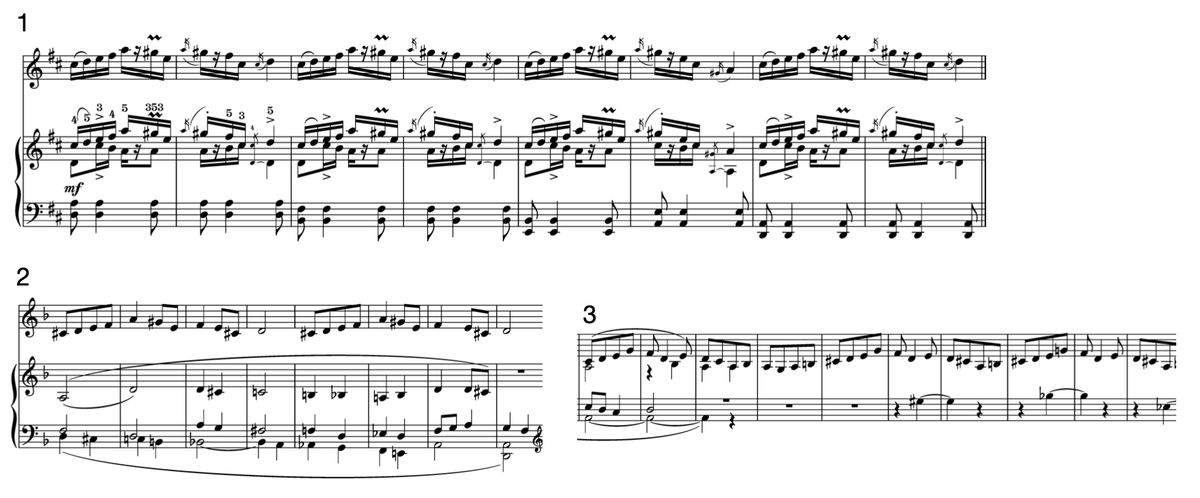
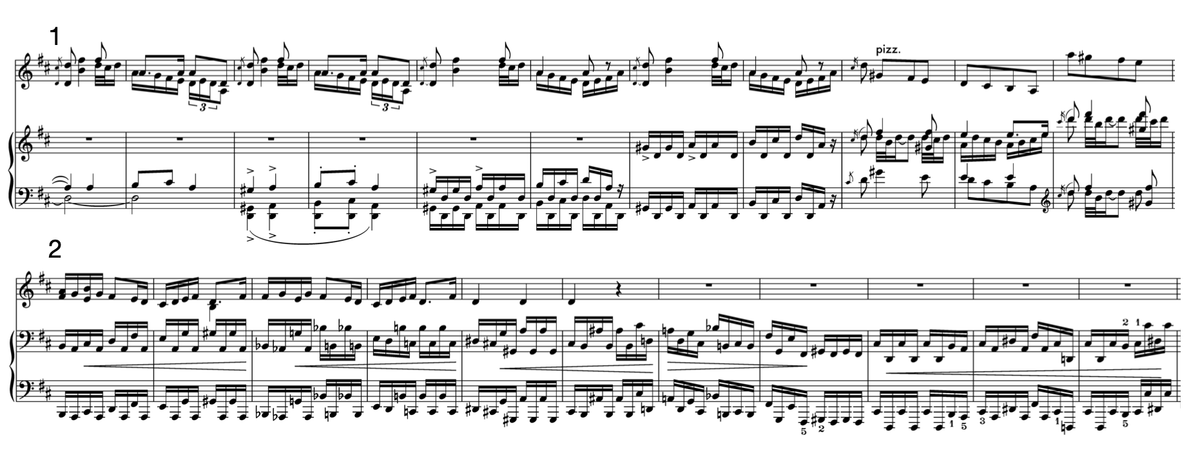
In this piece we chose to split in two distinct roles. First, the fiddle plays the melody traditionally, with the piano doing Grieg's left hand. Eight bars later, we swap roles: the piano takes over the melody and the fiddle does pizzicati. Ex.1.
The bold, 'train-like' bass figure of 16notes that Grieg introduces towards the end, inspired us to switch lines in another direction - maybe towards Béla Bartók? Ex.2.
Nils Rekve's Halling on youtube
12. WEDDING MARCH FROM TELEMARK
In this Wedding March we choose to enter the music gently and gradually from both sides, through improvisation and by using only selected elements from Grieg.
First, the fiddle gradually improvises its way into the slått.
(bars 1-7)
After 16 bars the fiddle has found the slått and plays it normally:
(the start of the traditional Wedding March)
The piano gradually moves towards Grieg's original, in a simplified version that retains the rhythmic character and a few pivotal notes.
At the start of next sound sample, a little detour to temporarily include some of Grieg's original romantic-style harmony:
(last 4 bars of 1st section, and start of 2nd section)
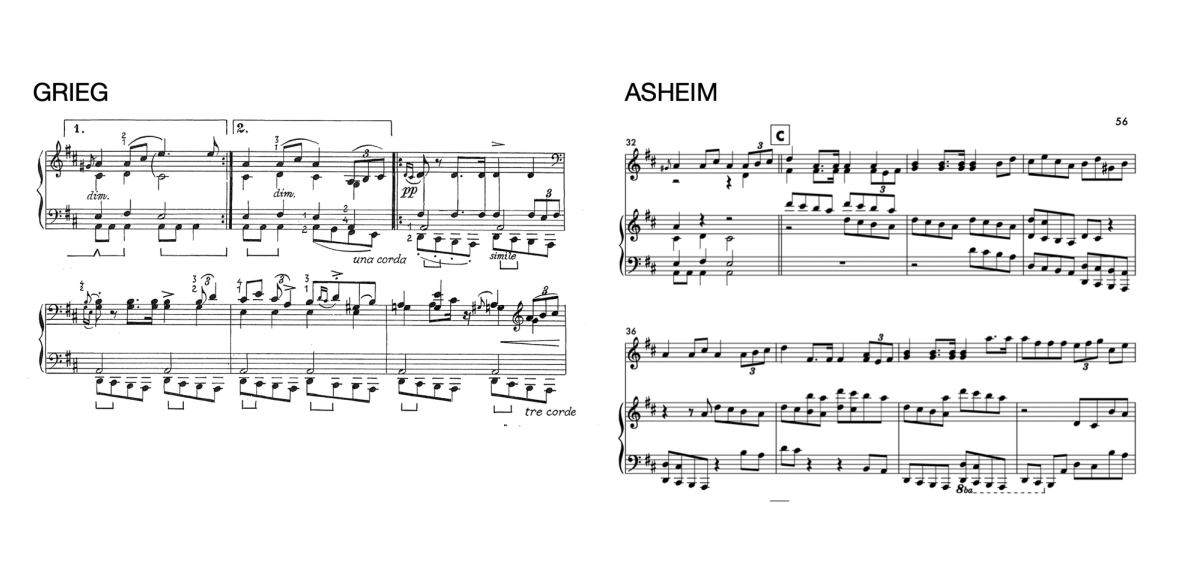
What you then heard (after these 4 bars) is the middle section of the March where, compared to Grieg’s version, the fiddle melody has been transposed up one octave. This respects how it is traditionally played on the fiddle and also was notated by Halvorsen in the transcriptions he wrote down for Grieg. Ex.1.
The bass line from bar 15 (repeated four-note pattern in pedal-point style), which in Grieg's piece is acoustically rather dominating, is in our version continuously shifted up and down in octaves, allowing the folk tune to emerge and the sonority of the Hardanger fiddle to project in a more varied way.
We keep original Grieg in bars 24–31 and from 41 to the end.
Wedding March from Telemark on youtube
13. GIBØEN'S WEDDING MARCH
A combination of the versions of Halvorsen and Johannes/Gunnar Dahle.
---
From the delicate, poetic wedding mood to a more bold and extrovert one. Why not give the fiddle the stage for the whole first part. With its proud horn-fanfare style, it definitely needs no piano help.
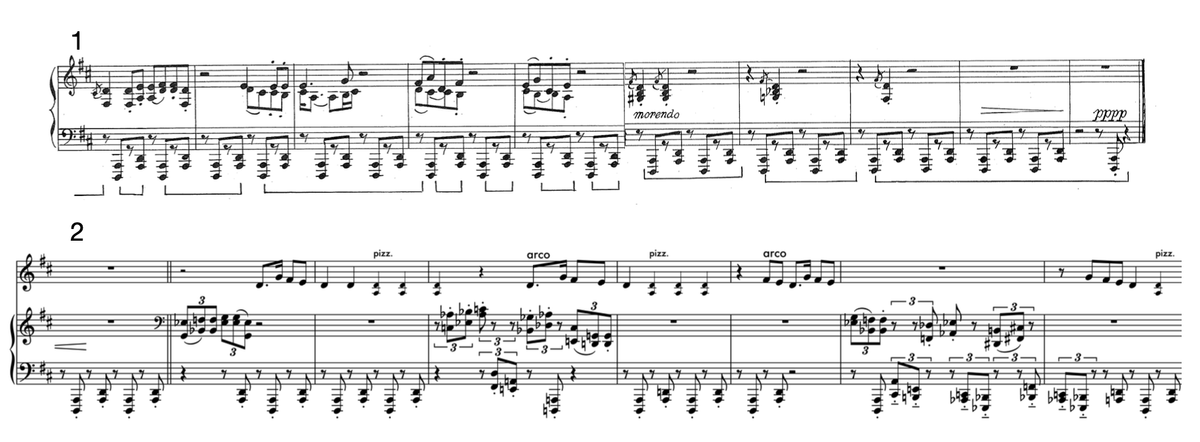
In Grieg's Opus 72, this Gibøen Wedding March is nr.1 and opens the whole collection in a quite evocative way, pianissimo, like a remote drum, as if a procession of underground spirits is approaching. Towards Grieg's ending, this mood returns (the procession disappears) in a very original, fragmented way (Ex.1).
So we decided to use the idea for the ending of the piece. The offbeat rhythm is played in a fade in / fade out way, and the fragments done a bit more playfully - with other bits of the slått, transposed both in pitch and in tempo (Ex.2).
Gibøen's wedding March on youtube
14. LURÅSEN'S HALLING I
The tune is often called "Gjerki Haukeland", which refers to the name of a girl who was engaged to be married to Knut Lurås' brother, Øystein. Knut accompanied Øystein to Haukeland near Bergen, where she lived, but when they arrived, a wedding was already going on – Gjerki had betrayed Øystein and married a richer man. Øystein then asked the bride to dance, and stripped her of the belt he had given her as a betrothal present. Knut played this tune for the dance.
Now for this piece and the next one the fiddle is retuned: GDAE (only fifths, similar to a classical violin). And this slått, an example of a Halling in 6/8 time (normally 2/4), runs in G major.
Many of the slåtter exist in numerous versions from around Norway. It was great fun to combine two versions of this one. The first one is a variant from Valdres, ‘Gamle Guro’ (‘Old Guro’).
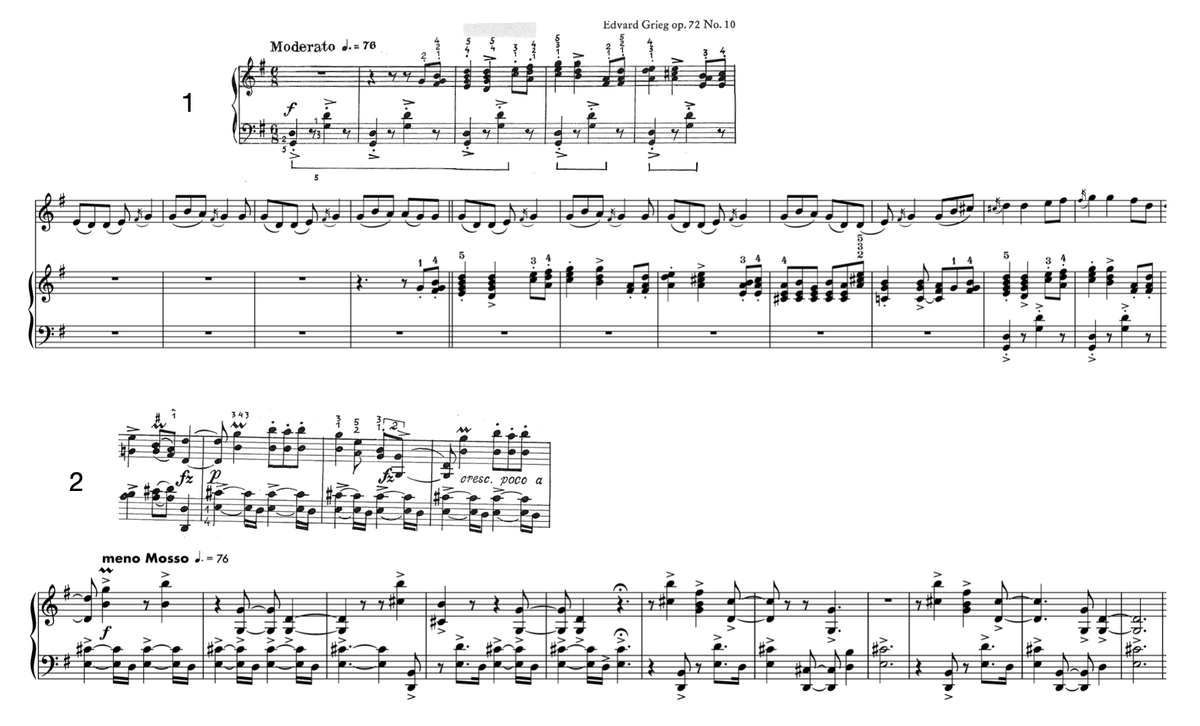
We let it play its first round, and as it restarts the piano joins with the Grieg/Halvorsen/Dahle version. Only we wait a bit with the left hand as you can see in Ex.1. Because the piano really has to make sure it manages to whirl into the fiddle's dance moves before playing in full.
Grieg writes a most insisting, accentuated passage (Ex.2) which made us feel 'this music aims for somewhere else!' - we expanded it to an epilogue, thinking of a music that shouted out from a cliff, listening to its own echo.
Knut Luråsen's Halling I on youtube
15. THE GOBLINS' BRIDAL MARCH AT VOSSEVANGEN / Tussebrureferda på Vossevangen, gangar
As the tune name indicates, it came to Telemark from Voss in Western Norway – the Telemark fiddler Leiv Sandsdalen (1825–96) had learnt it there. Knut Dahle learnt it from him, and adapted it to his personal playing style, which was more archaic than Sandsdalen's and also more so than the Western Norwegian fiddling style. Dahle's playing style (like his grandsons') was characterized by frequent microtonal deviations from the intervals of mainstream European music, a feature which is not reflected in Halvorsen's transcriptions. Nevertheless, we kept an echo of it in our introduction.
The prelude is partly based on the prelude notated by Halvorsen and included by Grieg in Op. 72, and partly on ‘Fyrispel after Knut Dahle’, as played by Johannes Dahle, which is an expanded version of the same (see recordings on Håvardspel, Talik Records 2009, and Rjukanfossen, Etnisk Musikklubb 2020).
Watch out for the fiddle’s intonation too! It is similar to that heard on recordings of Tussebrureferda by both Johannes and his grandfather Knut, as well as in recordings of the next two slåtter, Kivlemøyane I and II by Johannes, among others.
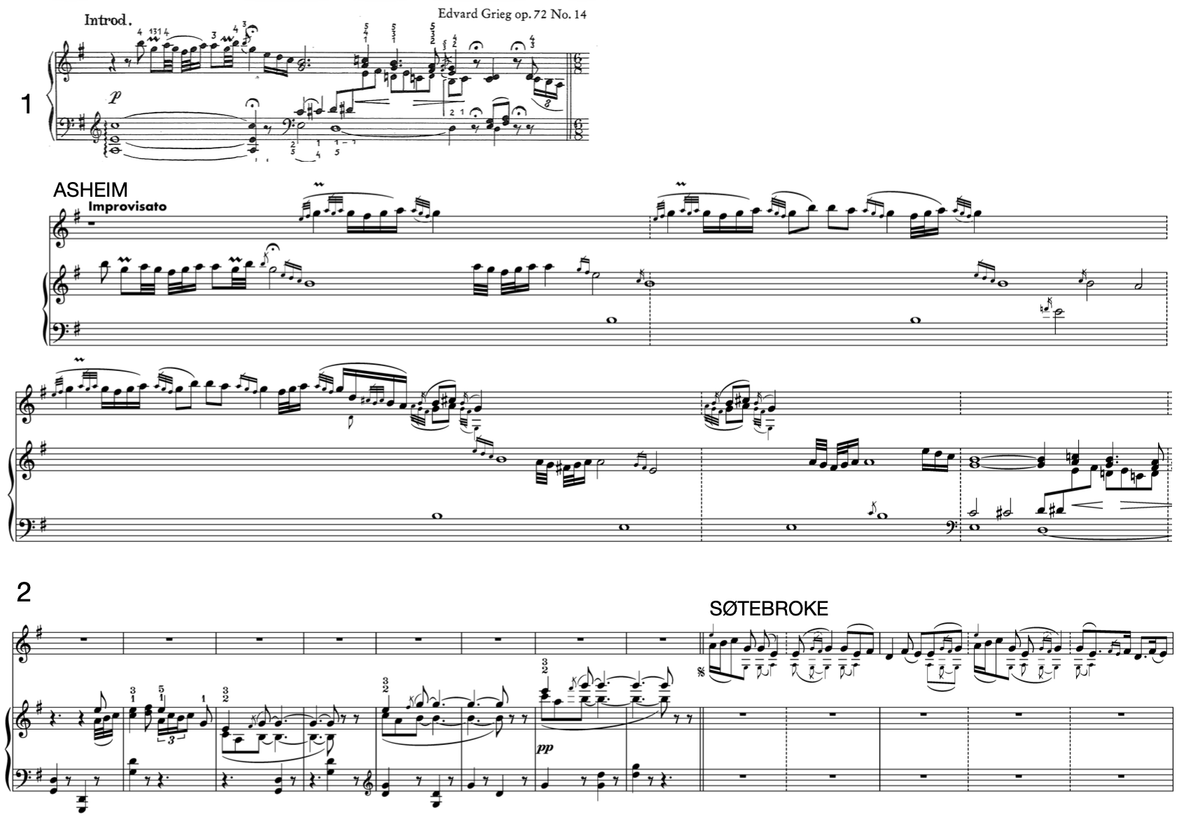
Ex.1 shows Grieg's introduction on the top, then our combination of Grieg-elements and the Fyrispel mentioned above. A special moment, deserving to last for a while (before finally being called back to civilization by Grieg):
Next sound example is the second part of the slått. Just notice how the fiddle's intonation makes Grieg's E-A-E-A... harmonies work out in a unique way! (no score example for this one).
You should soon sit down and listen to this intriguing piece in full. But first, two words about the epilogue which is an addition of our own: a variant from Valdres, a lydarslått (a slått meant for listening, not dancing) ‘Søtebroke åt Nertrøste’, created by Ivar Ringestad (1870–1953).
Listen to the moment (Ex.2) when Grieg retires and gently leaves the floor to the fiddle. Tuning: GDAE.
Tussebrureferda på Vossevangen on youtube
16 THE MAIDENS FROM KIVLE / Kivlemøyane, gangar
Two different series of slåtter are connected to the legend of the three sisters from Kivle, who disrupted the mass with their bukkehorn (ram’s horn) playing and were turned into stone by the priest. The other tune series employs the tuning AEAC#, this one the even less common FCAE. Knut Dahle learnt the gangar and springar tunes from Håvard Gibøen and later added a third tune to the series.
---
This is played in the tradition of Knut Dahle with B natural instead of B flat. Dahle himself likely played either B natural or a note between B flat and B natural, though Halvorsen transcribed B flat. Moreover: In this tradition, the high F is also often intonated higher than notated, somewhere between F and F sharp. This is the intonation our fiddle will use. The top F different from the medium and low ones. Let it sink in.
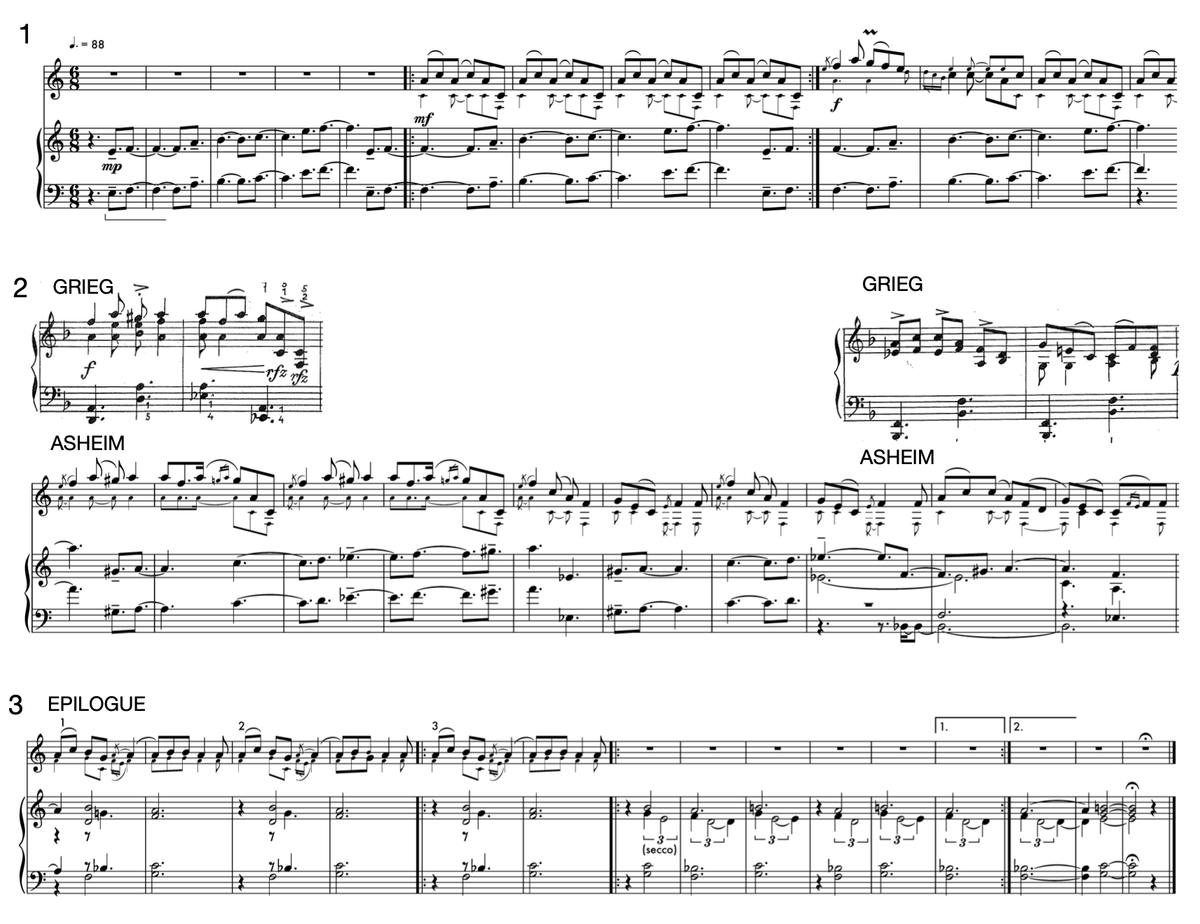
Now we are in a really archaic place. The tuning FCAE provides the bass drone F-C, which we want to hear. From the fiddle, as its whole sonority wraps the song into a kind of magic robe.
No need to borrow any Grieg yet. That's the reason for giving the piano just a symbolic little melodic counterpoint. Ex.1.
As Grieg starts to invent harmonies that give the tune some resistance, we take these pitches G# and Eb (Ex.2 left) and insert in our piano line. Next turn, a Bb bass note (Ex.2 right) (out of place in this intonation context) - which makes the bridge to Grieg's piano solo.
For sure we will say thank you to Edvard Grieg and leave him for a purely Lydian ending. Or will we keep the ambivalence to the very end, even cultivate it as a harmonic Janus Face? Ex.3
Kivlemøyane, gangar on youtube
17 THE MAIDENS FROM KIVLE / Kivlemøyane, springar
A Springar with asymmetrical metre, where the fiddle version differs that much from Grieg's interpretation that the two are best kept separate. Grieg's inverted rhythm (barline shifted one beat to the right) is also impossible to rectify without destroying his music. Thus, the "wrong" rhythm is kept in the piano and the correct one in the fiddle.
The fiddle starts (as in the former piece, in FCAE tuning) with a complete version.
Towards its end, it is time for the piano to begin feeling the room. Just like in piece nr.1, it warms up with a few notes that also give the fiddle tune a little harmonic pivot in Grieg style. Then, it goes solo on the main tune and one can only experience how far these two worlds are from eachother. You barely recognize the melody, even though our pianist tries to keep some of the fiddle's fluidity and rhythmical springar spirit.
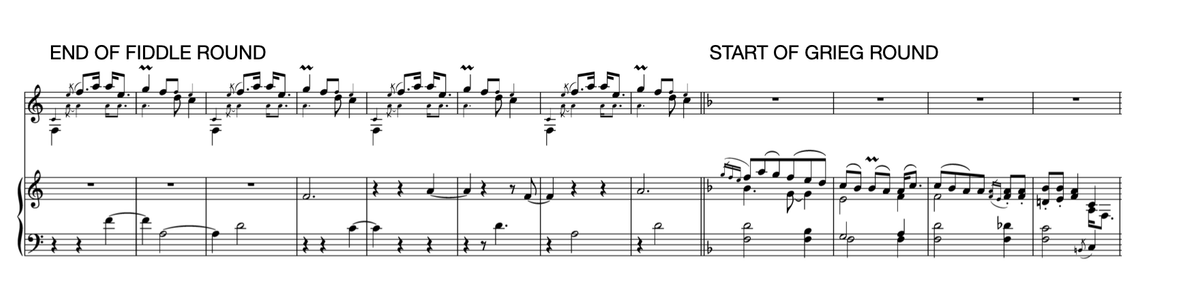
Finally, after some of the most beautiful piano lines ever written, the piano leaves Grieg and plays the last phrases of its slått in fiddle style, with just one hand. It's time to shake hands and for the fiddle player to take over. He has this treasure most close to his heart.
Thank you for following!
Kivlemøyane, Springar on youtube
_______________________
Download e-booklet of the album
_______________________
Sheet music sources:
Edvard Grieg: Slåtter / Norwegische Bauerntänze / Norwegian Peasant Dances Opus 72. Editions from 1903 (Peters) and further
Edvard Grieg: Slåtter op. 72 for klaver – Revidert utgave etter Dahle-tradisjonen på hardingfele. Ved Geir Henning Braaten og Sven Nyhus. Oslo, Musikk-Husets Forlag 2001
Johan Halvorsen: Norwegische Bauerntänze (Slåtter) für die Geige solo. Leipzig, Edition Peters 1903
Sven Nyhus: “Griegslåttene” – Ny utgave for hardingfele nedtegnet etter Johannes Dahle. Oslo, Musikk-Husets Forlag 1993. Addendum: CD with recordings of Johannes and Knut Dahle
Recordings:
Edvard Grieg: Slåtter / Norwegian Peasant Dances, Op 72. with the original fiddle tunes from Telemark. Knut Buen, Hardanger fiddle – Einar Steen-Nøkleberg, piano. Simax 1988
“Griegslåttene” – Hardingfeleinnspillinger av Johannes og Knut Dahle. Musikk-Husets Forlag 1993 (addendum to sheet music)
Edvard Grieg: Slåtter, Op 72. & the Knut Dahle slåtter. Ingfrid Breie Nyhus, piano – Åshild Breie Nyhus, Hardanger fiddle. Simax 2007
Ingfrid Breie Nyhus: Slåttepiano. LabLabel 2015
Unni Boksasp Ensemble: Opus 72017. Unni Boksasp Ensemble 2017
Literature:
Finn Benestad, Dag Schjelderup-Ebbe: Edvard Grieg – The Man and the Artist. Alan Sutton Publishing 1988
Knut Buen: “Som gofa spølå” – Tradisjonen rundt spelemannen Knut Dahle. Rupesekken forlag 1983
Håkon Asheim: “The original Slåtter used in Grieg’s op. 72”. Paper at the 2017 conference of the International Edvard Grieg Society. http://griegsociety.com/hakon-asheim-paper-2017/